Short answer: pick Rebonding (chemical straightening) if you want straight hair that lasts 3-6 months, and pick a heat iron for daily styling or if you have fine or damaged hair. Rebonding changes the hair’s internal structure with chemicals, while a heat iron only temporarily changes hydrogen bonds.
Who Is Rebonding For?
Naturally curly, thick or hard-to-manage hair, and anyone who wants long-lasting straight hair (3-6 months). Avoid it if there are cuts or inflammation on the scalp.
Rebonding Steps and Timings
- Hair assessment: make sure the hair is not coloured or badly damaged. Avoid if the scalp has cuts or inflammation.
- Apply the softener (H1): apply 1-2 cm away from the roots down to the ends. Waiting time: 10-25 minutes, depending on hair type.
- Elasticity test: pull a strand — if it springs back to 1.5x its original length, it is soft enough.
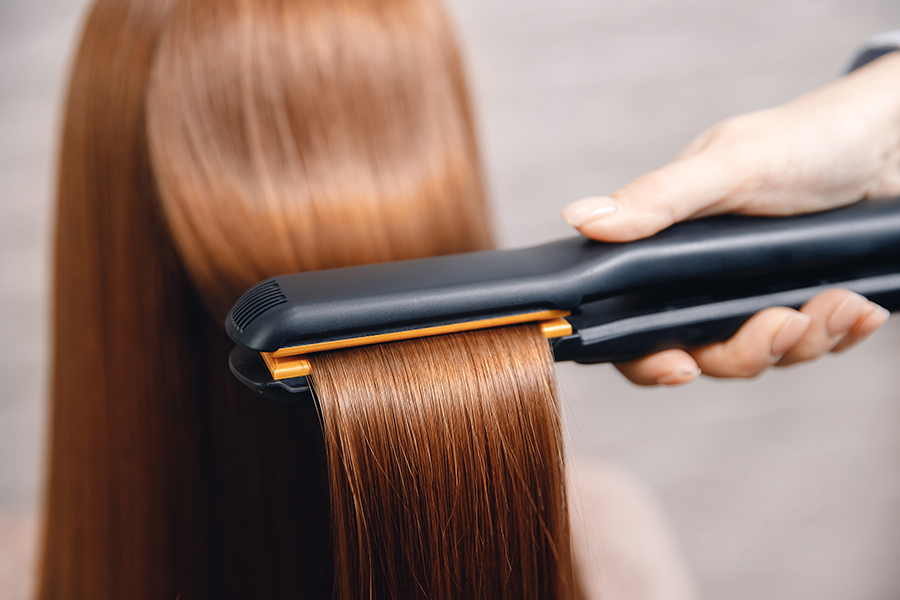
- Rinse and dry: rinse clean, dry, then use a 180°C flat iron to set the shape.
- Apply the neutraliser (H2): apply over the whole head, leave for 20-30 minutes, then rinse clean.
The Science Behind Rebonding
- H1: alkaline agents (e.g. sodium hydroxide) break the disulfide (S-S) bonds.
- H2: oxidising agents (e.g. hydrogen peroxide) re-form the disulfide bonds.
Rebonding Precautions
⚠️ Avoid contact with the scalp — risk of chemical burns.
⚠️ Use a keratin mask after the treatment to help the hair recover.
Who Is a Heat Iron For?
Daily styling, or fine and damaged hair where you want to avoid chemicals.
Heat Iron: Temperatures and Technique
- Preparation: dry hair to 80%, then spray a heat protectant (contains silicone).
- Section and set the temperature: fine hair 120-160°C; normal hair 160-180°C; thick hair 180-200°C.
- Straightening technique: glide slowly from 2 cm away from the roots to the ends. Do not go over the same strand more than twice.
- Cooling: finish with cool air to help close the cuticle.
Heat Iron: Science and Precautions
Heat temporarily changes hydrogen bonds; above 200°C it damages keratin. ⚠️ Never use it on wet hair — it can create “air bubbles” inside the hair. ⚠️ Clean the iron with alcohol regularly.
Rebonding vs Heat Iron: At a Glance
| Aspect | Rebonding | Heat Iron |
|---|---|---|
| Result | 3-6 months (permanent) | 1 day (temporary) |
| Damage | High (chemical) | Moderate (controlled heat) |
| Suitable for | Healthy, thick hair | All hair types |
| Difficulty | Needs a professional | Can be done at home |
Aftercare
- Sulfate-free shampoo: keeps the scalp pH at 4.5-5.5.
- Weekly hair mask: choose one with hydrolysed keratin or panthenol.
- Avoid excess heat: cut down on dryers and flat irons.
Summary
For thick, healthy hair that wants one long-lasting result, choose Rebonding — but keep up the aftercare. For daily styling with lower risk, use a heat iron and control the temperature and frequency. Rebonding must be done by a certified stylist. To ask about products or salon supplies, WhatsApp us or visit our product pages.
Leave a Reply
You must be logged in to post a comment.