
Tag: Hairstylist

  • Hairstylist Own Brand: Stop Being E-Commerce’s Free Coolie

    Hairstylist Own Brand: Stop Being E-Commerce’s Free Coolie

    To stop being squeezed by e-commerce price wars, hairstylists have to stop selling “standard products” and start selling a professional solution — diagnosis, service and salon-exclusive or white-label products bundled into one solution price.

    The source puts it bluntly: the root problem is not that customers love comparing prices. It is that you are spending your professional credibility and customer trust on products with transparent pricing and no barrier to entry — “like trading gold for cabbage”.

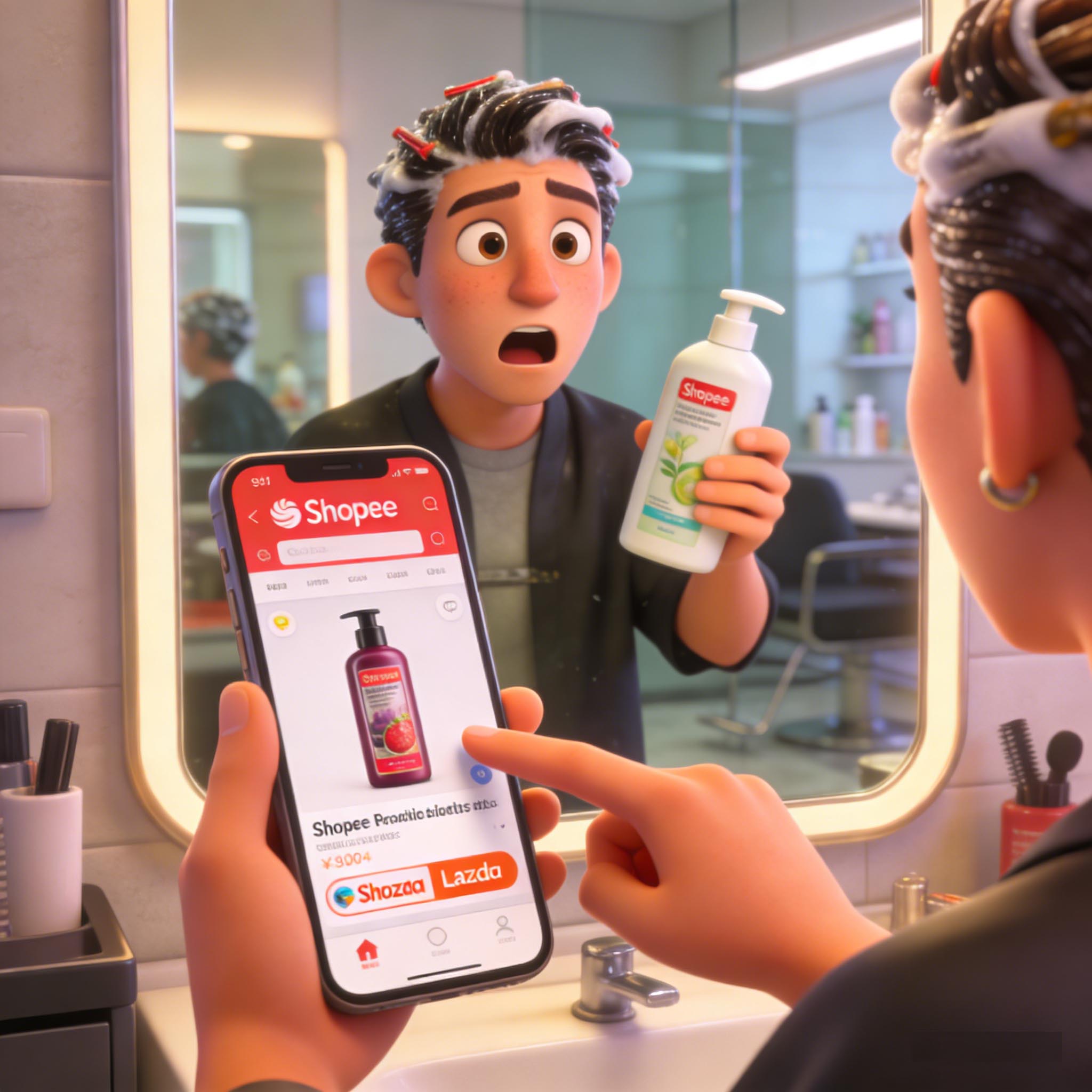
    Why do customers open Shopee or Lazada in front of you?

    Because you are selling a “standard product”, not a result only you can deliver.

    The source describes the scene: you stand at the mirror and spend 30 minutes using all your professional knowledge to explain how good a shampoo is. The customer looks interested, then suddenly takes out the phone, opens Shopee or Lazada, finds the same model and says it is cheaper there, so they will just buy online. At that moment, your professional knowledge has become free marketing for the e-commerce platform.

    The core shift: from product salesperson to professional solution provider

    Stop selling “goods” and start selling “professional results + a complete solution”. That is the core value no e-commerce platform can replace.

    3-step action plan

    Step 1: Change your base — drop the “pasar malam” products everyone can buy online

    Action: check your salon inventory. Any brand customers can easily buy cheap online — finish the stock and do not restock.

    • Look for “defensive” products: use brands available only through professional salon channels (the source cites the Shine Hair Zone exclusive series). The formulas are more concentrated, pricing is not transparent, and your margin is protected.
    • Talk about the “science of ingredients”: sell it like skincare. Do not just say “the hair becomes soft” — talk about “Hydrolyzed Keratin filling the gaps in the hair shaft”. You are not selling shampoo, you are selling hair care science.

    Step 2: Rebuild value — diagnosis + solution + product

    Action: drop the old “promotion” approach and build authority like a “hair doctor”.

    • Use “visual proof”: use a Scalp Scanner and let the customer see their own clogged follicles.
      • Upgrade your sales script: “Based on the diagnosis, your scalp is sensitive. I will prepare a ‘Home Care Package’ (Prescription Kit) — a deep cleansing treatment in the salon plus a special essence for home use.”
    • Bundled pricing: do not let the customer see the price bottle by bottle. Service + product = one solution price. This is what “Solution-Based Charging” means.

    Step 3: Level up the model — hold absolute pricing power

    Action: build a personal brand that cannot be swapped out.

    • Become an “Expert Curator”: build your image on social media (IG/TikTok) as a stylist who understands both ingredients and aesthetics. Customers buy because they trust your taste, not because of the product brand.
    • Explore “customisation” (own branding): the highest level of service is “Custom-Made”. Use the Shine Hair Zone supply chain to create your salon’s own “Signature” product.
      • “This bottle is a formula made specially for your hair — you won’t find it in any mall or online.” That line is the K.O. to price wars.

    ⚡ What you can change this week

    1. Filter your stock: any brand that is killing prices online — stop selling it.
    2. Change how you communicate: when a customer asks “what product is good?”, do not answer straight away. Take out the scanner and do a diagnosis first.
    3. Use a “Prescription Pad”: write your recommendation on the salon’s official diagnosis sheet. It looks more authoritative and is harder to price-compare.
    4. Keep customer assets: make sure customers who trust you join your WhatsApp/Telegram community. They are your future brand loyalists.

    Remember: customers come looking for “YOU”, not for the “SHAMPOO” on your shelf. It is time to take back your pricing power.

    FAQ for hairstylists and salon owners

    I run a small salon with limited capital. Can I still build my own brand?

    Yes. The source says you can start with white-label products at a low minimum order quantity. Shine Hair Zone offers options for small to large salons, and free consultation.

    How long before I see results after changing strategy?

    The source reports that many salons saw a 30-50% improvement in profit margin within 3-6 months after moving to a “solution + exclusive product” model.

    Will customers accept a higher price?

    Yes, if you deliver the value properly (diagnosis, prescription, proven results). Customers pay for expertise and a solution, not just a bottle of shampoo.

    What is “White Label” and how do I start?

    White label lets you put your own brand on products formulated specially for your salon. Shine Hair Zone helps with formulation, packaging and flexible minimum quantities.

    Ready to start the change?

    Do not let e-commerce platforms keep profiting from your expertise. Shine Hair Zone can help with:

    • ✅ Exclusive products for your salon
    • ✅ Scalp scanner and professional diagnosis tools
    • ✅ White label / own brand strategy
    • ✅ Free consultation for hairstylists and salon owners

    👉 Contact Shine Hair Zone for a consultation, or view the Shine Hair Zone exclusive series. Specific pricing is not stated in the source — ask us directly for the latest details.

    Summary: swap the 30-minute product talk for a proper diagnosis, and swap standard products for salon-exclusive or white-label formulas — that is how you take back your pricing power.

  • Rebonding Hair Straight: 3 Tips Every Hairstylist Needs

    Rebonding Hair Straight: 3 Tips Every Hairstylist Needs

    Short answer: When a client’s hair reverts after a few washes at home, it is usually not weak technique but the “stubborn nature” of curly hair that was ignored — the natural cuticle scales are uneven, the cortex holds a lot of keratin, forcing it straight breaks the hair, and skipping the shape-locking step makes it spring back fast. Master the three stages of softening, temperature and shape locking and the straight result can hold for 3-6 months.

    Stage 1: Softening is not about forcing it hard — follow the hair type

    Softening is the foundation. It is better to go shorter in time than to over-soften, and better to soften lightly than too strongly. Different hair types need different strengths:

    • Thick, coarse curly hair: use a medium-strength softener (contains 15% ammonia), section the hair first (each section 2cm wide), start applying from the mid-length and leave 1cm at the ends (the ends are already damaged), then wait 8-10 minutes. Test one strand every 2 minutes — if it stretches to 1.5 times its original length and does not spring back when released, rinse immediately.
    • Fine, soft curly hair: use a low-strength softener (contains 8% ammonia), apply a thin layer over the whole head and wait 5-6 minutes. The test standard is the same; do not wait longer or the hair turns into “cotton candy” and breaks easily after straightening.
    • Damaged curly hair (coloured or bleached): apply a layer of hair care oil as a base first, then use an ammonia-free softener and wait 3-4 minutes. Rinse once the test strand stretches to 1 time its size, then lower the straightening temperature by 10℃.

    Stage 2: Temperature and tension during straightening decide whether it reverts

    Good softening does not guarantee a successful straightening. If the flat iron temperature and tension are wrong, all the earlier work is wasted.

    • Temperature choice: thick, coarse hair 180-190℃, fine soft hair 150-160℃, damaged hair 140-150℃. Remember “lower is better than higher” — high heat only cracks the cuticle and makes the hair revert more easily.
    • Tension technique: the flat iron must move in the direction of the cuticle (from root to tip, following the hair growth direction), and each section is ironed 2-3 times: the first pass is light (setting the shape), the second pass uses medium pressure (straightening), the third pass is light (locking in the smoothness). Do not iron back and forth repeatedly, or the hair overheats and gets damaged.
    • Root handling: start ironing 1cm away from the root to avoid burning the scalp with high heat. Lift the hair at about a 30℃ angle so the root keeps a little volume; do not press it flat against the scalp, or the client will feel it is “flat, stiff and unnatural”.

    Stage 3: Shape locking and aftercare hold the straightness

    Many people rinse and dry the hair and call it done — that step is the trigger for reversion. After curly hair is straightened the cuticles are still open, so you must do “shape locking + rehydration”:

    • After rinsing: use an acidic colour-locking conditioner (pH 4.5-5.5), apply through the hair and leave for 5 minutes to neutralise the alkalinity of the softener and close the cuticles — this step can make the straightening effect last more than 1 month longer.
    • Drying technique: use medium-low heat and dry from the mid-length to the ends in order. When the hair is 80% dry, comb it with a wide-tooth comb, then use cold air to set the shape for 30 seconds to improve smoothness.
    • Aftercare instructions for the client: always teach the client how to care for it at home — no washing, tying or heat ironing for 48 hours; wash with silicone-free shampoo plus conditioner; use a hair mask once a week for deep care; and dry the hair in the direction of the cuticles, never against them.

    Mistakes to avoid: do not make these 3 mistakes

    1. Do not straighten too thick a section at once: each section should not be wider than 2cm, or the middle layer gets no tension and the straightening is uneven.
    2. Do not iron straight after softening without rinsing: leftover softener corrodes the hair, so it breaks easily and reverts quickly.
    3. Do not ignore the ends: if the ends are badly damaged, trim 1-2cm after straightening to stop frizz from spoiling the overall result.

    FAQ

    Q: How long can rebonded hair stay straight?
    Answer: With correct technique (softening according to hair type, accurate temperature, proper aftercare), the hair can stay straight for up to 3-6 months. After that, new growth curls back naturally.

    Q: Can damaged hair be rebonded?
    Answer: Yes, but be more careful. Use an ammonia-free softener, apply a protective oil first, shorten the softening time and lower the flat iron temperature by 10℃ from usual.

    Q: What if the client’s hair is still curly after rebonding?
    Answer: It is usually uneven softening or a flat iron temperature that is too low. For mild cases, re-iron the parts that are not straight. For severe cases, wait 2-4 weeks before rebonding again to avoid damaging the hair.

    Q: Can the client wash the hair right after rebonding?
    Answer: No. The client must wait at least 48 hours (2 days) before washing. During this time, also avoid tying the hair or using heat tools.

    The essence of straightening curly hair is working with its natural nature, not forcing it down. Get the three stages of softening, temperature and shape locking right, and clients will stop complaining that it reverted — they will recommend you to their friends. To upgrade your rebonding skills or ask about professional salon products, WhatsApp Shine Hair Zone for a consultation.

  • Customers Challenging Hair Loss Products? 3 Pro Scripts

    Customers Challenging Hair Loss Products? 3 Pro Scripts

    Customers ask: “Will my bald patch grow back with your shampoo or tonic?”, “My whole family is bald anyway, why waste money?” and “How long before I see results?” — almost every hairstylist faces these three questions. Here are professional answer scripts based on facts and experience. The key is never to overclaim, and to explain the scalp-environment logic first.

    Question 1: “Will bald hair grow back with your shampoo or tonic?”

    (The customer is sceptical and thinks it is a magic cure.)

    ❌ Do not answer: “Can one boss, guaranteed to grow!” — that is an overclaim, and the customer will turn on you when it does not happen.

    ✅ Professional answer:

    “Boss, shampoo and tonic are not magic. Their main job is to make the ‘soil’ fertile: they help remove oil, kill germs and improve blood circulation in the scalp. When the ‘soil’ (the scalp) is healthy and not clogged, hair can grow normally. If the scalp is not treated first, no fertiliser will work.”

    Question 2: “Men go bald anyway. My family is all bald. Why waste money?”

    (The customer has given up / fatalist.)

    ✅ The “40 vs 60” logic answer:

    “Boss, we cannot change genetics. But we can change when it happens. The difference between caring and not caring is TIME:

    • If you do not care: you may be completely smooth by 40.
    • If you care: we can delay visible baldness until 60.

    So this product works to slow the process down. Do you want to look old at 40, or stay looking young until retirement? The choice is in your hands.”

    Question 3: “How long before I see results? I have tried many products with no effect.”

    (The customer is impatient.)

    ✅ The science-fact answer (14 days):

    “Give it at least 14 days. Why? Because the hair follicle cycle takes time.

    How do you know it is working? Do not look at hair length first. Look at these two things:

    1. Less hair falling on the bathroom floor.
    2. New hair roots that feel coarser and thicker than the fine hair before.

    If one bottle feels like it has no ‘kick’, you can switch brands. The body can become immune (lalis), so products need rotating. But never stop caring for the scalp.“

    FAQ: Common Questions from Hairstylists

    How do I answer a customer who says anti-hair-loss products do not work?

    Use the “fertile soil” approach: the product cleans the scalp first, and only then can hair grow. Give it 14 days and watch for less shedding and thicker roots.

    What if the customer says “my genetics means I will go bald”?

    Use the “40 vs 60 Rule”: genetics cannot be changed, but the balding process can be slowed. The product helps the customer “buy time” to look young for longer.

    How long must a customer use it before seeing results?

    A minimum of 14 days to see less hair fall. For noticeable new hair growth, usually 2-3 months. Consistency is the key.

    Summary and next step

    Anti-hair-loss products are always the No. 1 best seller in the professional market, because hair loss is everyone’s problem, young or old. Remember this line: “The customer’s image is our responsibility.” When a customer looks handsome and young because of thick hair, we are proud too. So do not be afraid to educate customers — we are not forcing a sale, we are helping them buy time. Want more sales scripts for hairstylists? WhatsApp us or visit the hair salon & barbershop product page.

Hair Problem?WhatsApp me