
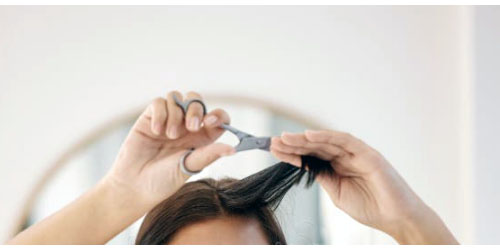
Cutting your own split ends usually makes them worse, because the problem is the tool, not the trimming. Household scissors are not sharp enough, so instead of cutting cleanly they crush the ends into an uneven “shredded” edge. The fix is a dusting trim with sharp, sharpened scissors that removes only the split portion without losing length, plus a salon trim every 8–10 weeks.
Why DIY trimming multiplies split ends
Conclusion: blunt scissors crush the hair rather than cutting it. Ordinary scissors press through the ends and leave an uneven “shredded cut”, so each rough point becomes a new spot where the strand can split — hair often looks frizzier after a home trim, not smoother.
The correct method: a dusting trim at the salon
Conclusion: let the salon trim with sharp scissors, using a “dusting trim” that removes only the split portion without sacrificing length. Make sure the salon uses sharpened scissors.
How often should you trim?
Conclusion: trim the ends every 8–10 weeks so splits do not spread; the prevention checklist puts it at once every 2 months to stop them coming back. Leave at least 3 months between colouring and rebonding or perming, so the same hair is not hit with back-to-back processing.
Split ends are not only a scissors problem
- Vitamin deficiency: a lack of biotin (B7), vitamin E and B-group vitamins weakens the cuticle and makes strands brittle. Include more eggs, avocado, salmon, nuts and leafy greens; take biotin or a multivitamin only under a doctor’s guidance.
- Hair ageing: as hair ages the cuticle wears down and the ends dry out and split, especially at the tips of long hair. Use a silicone-based hair serum or oil such as argan oil on the ends.
- Chemical products: styling products such as hairspray and straightening creams that contain Parabens and SLS (sodium lauryl sulfate) strip the hair’s natural oils and cause dryness and splitting. Choose shampoos and treatments labelled “SLS-free” and “Paraben-free”.
Heat and UV: the two most overlooked causes
Conclusion: heat and sun both lift the cuticle and drain moisture. With a blow dryer, spray heat protection first, keep the setting on low to medium, hold the dryer at least 15cm away, and use it no more than 2–3 times a week — air-drying should be the default. Outdoors, long sun exposure dries, fades and weakens hair, so wear a hat or use an SPF sun-care spray; coconut oil or argan oil form a natural UV barrier.
Daily habits: wet hair vs dry hair
Conclusion: rubbing wet hair hard or yanking a brush through dry hair both make splitting worse. Pat the water out with a towel instead of rubbing back and forth, use a wide-tooth wooden comb on wet hair, and mist a little leave-in spray through dry, knotty hair.
Key takeaways
Split ends are irreversible — once a hair splits it can only be cut off, and daily care only slows the damage. Scalp health comes first: massage the scalp regularly to boost blood circulation and strengthen hair from the root.
Anti-split-ends action checklist
Nourish from within: daily protein plus B-group vitamins. Fight the heat: heat protection spray before every blow-dry. Trim regularly: once every 2 months. Avoid chemical damage: fewer colouring and rebonding sessions. UV protection: a hat outdoors or sun-care hair products. Right care habits: towel-dry gently, comb dry hair with a wide-tooth comb.
Summary: preventing split ends comes down to diet, care habits and product choice, while trimming belongs to the salon’s sharp scissors. Looking for shampoo, treatment or salon-range products? Message our team on WhatsApp or browse the product page.