Rebonding and flat iron both give you straight hair, but the mechanism is completely different: rebonding uses chemicals to change the hair structure from inside and lasts 3-6 months, while a flat iron only uses heat and the effect disappears the next time you wash your hair. The right choice depends on your hair condition, how long you want the result to last, and how much damage risk you are willing to accept.
Rebonding: 3-6 months of straight hair, but the highest risk
Rebonding is a chemical process that alters the internal structure of the hair so curly hair becomes permanently straight. The result lasts, but the risk is also the highest.
Who is it suitable for?
- Natural curls, coarse and hard hair, or resistant hair
- People who want a one-time treatment that stays straight for 3-6 months
- Precondition: the hair must be healthy, not bleached or coloured, and the scalp must have no wounds
The professional process
- Assess the hair: confirm there is no bleaching, no severe damage, and no wound on the scalp.
- Apply the softener (H1): keep 1-2cm away from the roots and apply evenly. Wait 10-25 minutes and check every 5 minutes (the stretch test should rebound about 1.5 times for the best result).
- Rinse and set with a flat iron: rinse thoroughly, blow dry, then straighten small sections with a flat iron at 180°C.
- Apply the neutralizer (H2): apply over the whole head, leave for 20-30 minutes, then rinse thoroughly to stop the chemical reaction.
Why it works
- Softener: breaks the disulfide bonds (S-S) inside the hair so the strands become soft and mouldable.
- Neutralizer: rebuilds those S-S bonds and locks the straight shape in place.
⚠️ Risks you must know
- Chemical burns: the softener contains strong alkaline ingredients; contact with the scalp can cause redness and burns.
- Hair breakage: if the hair is already damaged, the chemicals will damage its structure further.
- Irreversible: once the hair is over-softened it cannot be repaired, only cut off.
My advice: rebonding is never a home DIY project. If you decide to do it, go to a professional stylist, and start a weekly keratin mask right after to replace the protein the chemicals took out.
Flat iron: temporary straightening you fully control
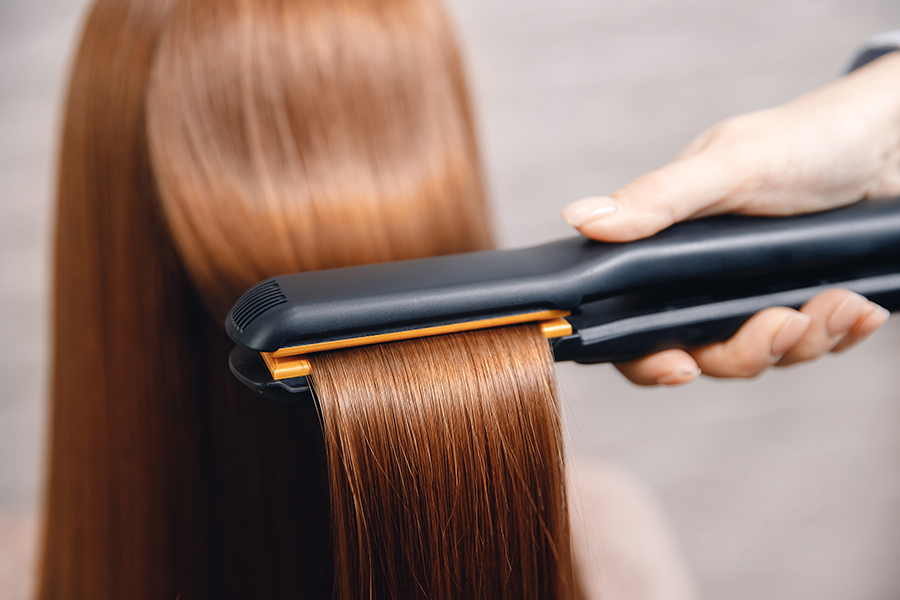
This is the everyday method: wash, blow dry, then straighten section by section with a flat iron. The effect only lasts until your next wash, but you stay in full control.
When it fits
- Quick styling before going out
- Fine, soft hair and already damaged hair — the group that should not touch chemicals again
The correct steps
- Protect first: after washing, blow dry until almost dry, then spray heat protectant evenly.
- Section the hair and set the temperature:
- Fine hair: 120-160°C
- Normal hair: 160-180°C
- Coarse hair: 180-200°C (never exceed 200°C)
- Straightening technique: start 2cm away from the root and pull down slowly and evenly. Do not pass over the same section more than 2 times, and keep each pass to 3-5 seconds.
- Cool and set: right after straightening, blow cool air over the hair to help the cuticles close.
How heat straightens hair
High heat temporarily breaks the hydrogen bonds in the hair, so the hair goes straight. When it meets water (washing), the hydrogen bonds return and the hair goes back to its original shape. Damage comes from temperatures above 200°C, which destroy keratin and cause dryness and split ends that cannot be reversed.
⚠️ Safety tips
- Never flat iron wet hair: the water inside the hair turns to steam instantly, forming bubbles inside the strand — this is bubble hair, and the hair breaks from inside.
- Clean the flat iron: leftover styling product reduces heat transfer, so wipe it with an alcohol swab once a week.
Quick comparison: rebonding vs flat iron
- Durability: rebonding 3-6 months (permanent); flat iron less than a day — it is gone once you wash your hair.
- Type of damage: rebonding chemical damage (high risk); flat iron heat damage (controllable).
- Hair type: rebonding suits healthy uncoloured hair and coarse hair; a flat iron suits all hair types as long as the temperature is adjusted.
- Who can do it: rebonding must be done by a professional; a flat iron you can do yourself.
- Upfront cost: rebonding needs a higher one-time investment; a flat iron only needs the tool plus heat protection products.
After-care decides the final result
- Change your shampoo: use Ionic Nutritive Shampoo and Ionic Nutritive Conditioner (pH 4.5-5.5) to help the cuticles close.
- Deep treatment weekly: once a week, use a deep hair mask (with hydrolyzed keratin or panthenol).
- Trim split ends: split ends cannot be repaired; if you do not cut them, they travel further up.
- Wash less often: 2-3 times a week is enough, because washing too often makes the straight effect fade faster.
Summary
If your hair is healthy and you want to forget about curls for 3-6 months, rebonding is the fit — but have a professional stylist do it and never skip the after-care. If your hair is already damaged, or you only want straight hair once in a while, a flat iron with a heat protectant is the safer route. Whichever you pick, one principle stands: hair health comes before styling. Still unsure which suits your hair type? Send us a photo of your hair on WhatsApp for a free assessment, or view our product page.
Leave a Reply
You must be logged in to post a comment.