
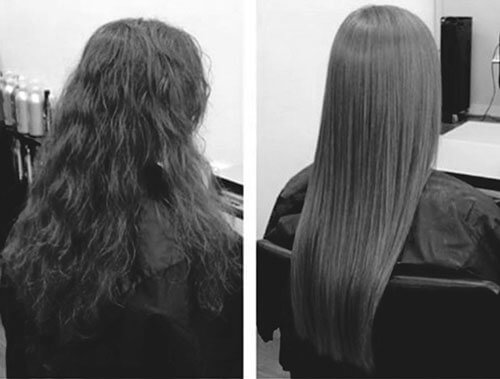
You can rebond your hair at home: apply Step 1 Hair Softener and leave it for 10-20 minutes (up to 25 minutes for very thick hair), rinse and blow-dry, flat-iron at 180°C, then apply Step 2 Neutralizer for 20-30 minutes to lock in the straightness. The one thing that decides whether it works is the stretch test – rinse too early and the hair stays wavy, rinse too late and it snaps.
What do you need before you start rebonding at home?
A complete rebonding straight cream set, a flat iron that can reach 180°C and basic tools are enough – you don’t need salon equipment.
- Step 1 Hair Softener: softens the hair structure so it can be straightened easily.
- Step 2 Neutralizer: locks in the straightened result.
- Flat iron (catokan): the temperature must go up to 180°C.
- Hair dryer, towel, clips, wide-tooth comb, gloves.
The Step 1 Hair Softener and Step 2 Neutralizer in the source come from the same product page, so you can check the specs there.
Step 1: How do you apply the Hair Softener and how long do you leave it?
Apply it evenly, keep it 1-2 cm away from the roots, and rinse the moment the time is up instead of dragging it out.
- Apply evenly: work the cream from the mid-lengths to the ends, keeping 1-2 cm away from the roots so it does not touch the scalp.
- Reaction time: leave it for 10-20 minutes; for very thick hair you can go up to 25 minutes.
- Rinse and flat-iron: once the hair is soft enough, rinse with warm water until clean, dry the hair, then flat-iron at 180°C to set the shape.
Step 2: How do you use the Neutralizer so the straightness holds?
- Cover the whole head: apply the neutraliser evenly from the roots to the ends.
- Wait and rinse: comb gently with a wide-tooth comb, leave it for 20-30 minutes, then rinse thoroughly so no residue is left behind.
Stretch test: how do you know the hair is soft enough?
This is the most critical step. Too early and the hair will not be straight; too late and it breaks. Take one strand from the thickest section and hold both ends:
- It stretches to 1.5 times its original length and springs back slowly – it is ready, rinse immediately.
- It snaps straight away – wait another 3 minutes and test again.
- It stretches like rubber and does not spring back – it is over-softened, rinse at once.
For a more detailed explanation of the stretch test and how to read the results, read: Cara Tahu Rambut Dah Lembut Masa Rebonding.
How should you care for your hair after rebonding?
The source notes that the straightened result can last about 3-6 months if you use the right aftercare.
- Use a sulfate-free shampoo: it helps keep the hair cuticle closed so the straightening lasts longer.
- Add nourishment: use a protein or keratin hair mask at least 1-2 times a week to keep the hair strong.
What safety precautions should you take?
Safety comes first whenever you put chemicals on your hair. The points the source lists are:
- Keep the softener 1-2 cm away from the roots and off the scalp.
- Rinse with warm water, and rinse the neutraliser until there is no residue at all.
- Keep the flat iron at 180°C – don’t turn it up just to save time.
- Once the hair is over-softened, rinse immediately instead of pushing on.
Things the source does not state, such as how much cream to use for different hair lengths or how long an opened bottle keeps, are best confirmed on the product packaging or with a professional.
Summary: at-home rebonding lives or dies on the softener timing and the neutralising step – 10-20 minutes softening, 180°C flat iron, 20-30 minutes neutralising – and with sulfate-free shampoo plus a mask 1-2 times a week the straightness holds much longer. To buy rebonding cream or to check whether your hair type is suitable, WhatsApp us or have a look at the product page.
Leave a Reply
You must be logged in to post a comment.